

Leica M, Leica S, Leica SL, Leica CL

peterv;8441 wrote: Yes, Sony said some time ago that they wanted to be disruptive and innovative. I welcome that, but for us poor guys and girls who’ve invested in an interchangeable lens system, a curved sensor is most likely not going to be in the cards. Though I wouldn’t mind a pocket-sized MF RX1 😎
http://nofilmschool.com/2014/06/sonys-curved-cmos-sensor-sharper-faster-lenses/?hvid=6rKd5
The other day I red – I think it must have been on some Leica forum – that CMOSIS makes ‘better’ sensors than Sony. I find that hard to believe. Especially given the R&D budgets of these respective companies. And what means ‘better’? For us S users what matters most is the look and quality of the file the camera system produces.
Fingers crossed for a new and popular S, because I wouldn’t mind if the S system became a bit more widely used. A broader user base would make me feel more secure about the longevity of the system. Especially with technology moving forward so fast.
Peter,
I think the “better” terminology is referring to the more modern CMOS design that Leica and CMOSIS employed in making the MaxCMOS sensor for the M (Typ 240). It has a much shallower pixel well depth as well as a new microlens shape that negates any ill effects of high incidence angle lenses. I recall reading an article in a semiconductor industry magazine that the CMOSIS sensor in the M is the thinnest CMOS ever made by any company.
As can be seen in the many user reports of putting anything wider than a 35mm M lens on a Sony A7r, high incidence angle (non-retrofocus) lenses have serious when used with Sony’s sensor. The sensor was designed to be used in DSLRs like the D800 with highly telecentric retro-focus designs, not a short throw mirror-less system. Yes, Sony’s own lenses have a more tele-centric light path and/or correction algorithms that work around this design limitation. This is little consolation to those that figured the A7r would be a great platform to use wide angle M lenses.
Leica often gets credit for making stellar lenses, but few acknowledge how advanced they have become in digital technology. Leica co-designed the MaxCMOS chip with CMOSIS, wanting to control the process – something that wouldn’t happen if they had just used an off-the shelf sensor. If a CMOS sensor does make its way into an S camera, I’m sure that Leica will go their own way, which is a good thing.
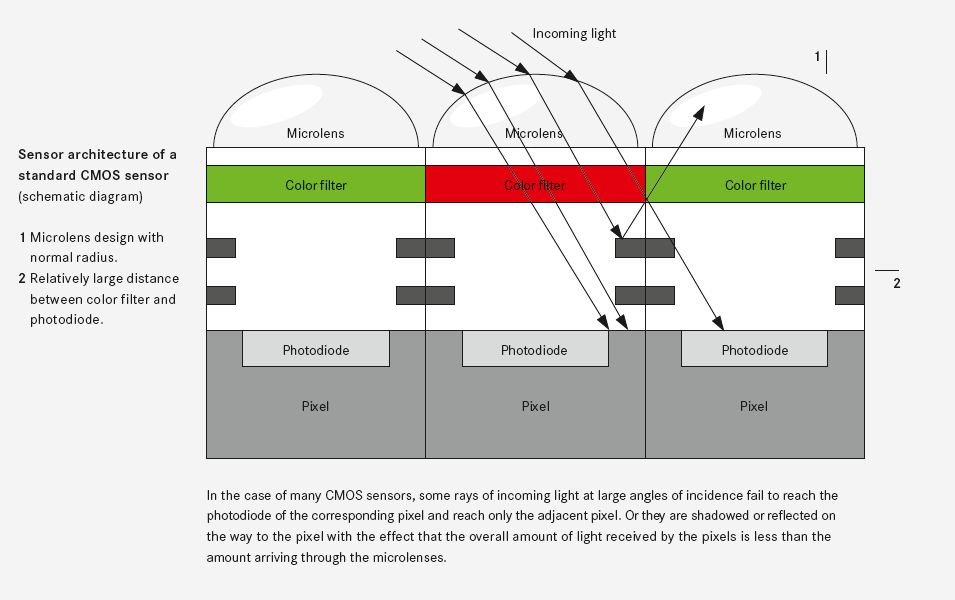
Standard CMOS sensor
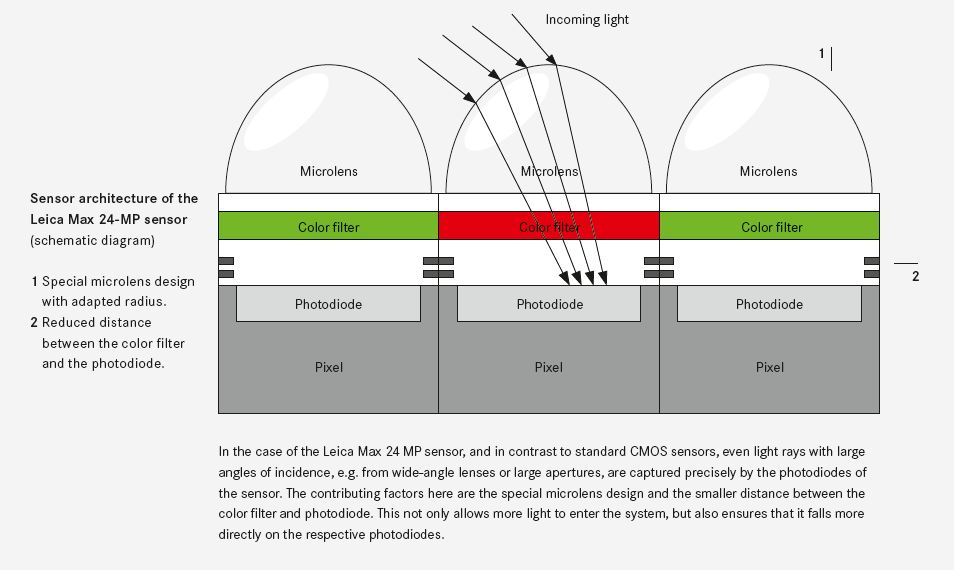
Leica MaxCMOS sensor
Red Dot Forum
Leica Store Miami