-
PebblePlace replied to the topic And here we go. The NEW S2! in the forum Leica S (Typ 006) 13 years, 10 months ago
If Leica adds the control wheel option, remedies the bugs already noted, then I think that is a good finish to the S2. I do not foresee them offering the ISO now (even if they could) because that makes the new S alittle less enticing. I would like to see 1/2x, 1/3x and 1/4x added to the Auto-ISO parameters. One-over-the-focal length is too…[Read more]
-

David Farkas replied to the topic And here we go. The NEW S2! in the forum Leica S (Typ 006) 13 years, 10 months ago
PebblePlace;3287 wrote: It is very unlikely we would see the ISO steps change on the S2 because that is linked to the hardware and the amount of amplification performed by the hardware. Generally ISO starts with a base level hardware amplification and then some or all the subsequent ISO increments are extrapolated by the camera's software.…
-
David Farkas replied to the topic And here we go. The NEW S2! in the forum Leica S (Typ 006) 13 years, 10 months ago
PebblePlace;3293 wrote: For the 120mm TS, you may want to consider the Mamiya / Phase One mount ($4643 at B&H) and the S / Mamiya adapter ($875 at retail). That combo is $1500 less. Both lenses are fully manual with no automatic aperture.
FYI, the 120mm Schneider in Mamiya mount is also available at Dale Photo & Digital. The Leica version…[Read more]
-
PebblePlace replied to the topic And here we go. The NEW S2! in the forum Leica S (Typ 006) 13 years, 10 months ago
For the 120mm TS, you may want to consider the Mamiya / Phase One mount ($4643 at B&H) and the S / Mamiya adapter ($875 at retail). That combo is $1500 less. Both lenses are fully manual with no automatic aperture.
-
aboudd replied to the topic And here we go. The NEW S2! in the forum Leica S (Typ 006) 13 years, 10 months ago
Josh Lehrer;3109 wrote: The Leica Vario-Elmar-S 30-90mm f3.5-5.6 ASPH will be priced at $9,950 and the Leica Super-Elmar-S 24mm f3.5 ASPH is $7,450.
Put me on the list for the 24 and let me know the freight for the 120 T/S
-
PebblePlace replied to the topic And here we go. The NEW S2! in the forum Leica S (Typ 006) 13 years, 10 months ago
It is very unlikely we would see the ISO steps change on the S2 because that is linked to the hardware and the amount of amplification performed by the hardware. Generally ISO starts with a base level hardware amplification and then some or all the subsequent ISO increments are extrapolated by the camera's software.
Leica had previously…[Read more]
-
Brian replied to the topic Coming home… in the forum M Monochrom 13 years, 10 months ago
Congratulations, be sure to post some pictures.
I bought my first rangefinder- a Minolta Hi-Matic 9, when I was 11. A whole Summer of mowing lawns.
I'm sure to be as excited when my M Monochrom arrives. I'll have to load up the Hi-Matic 9 with some B&W film.
-
Leica Store wrote a new post 13 years, 10 months ago
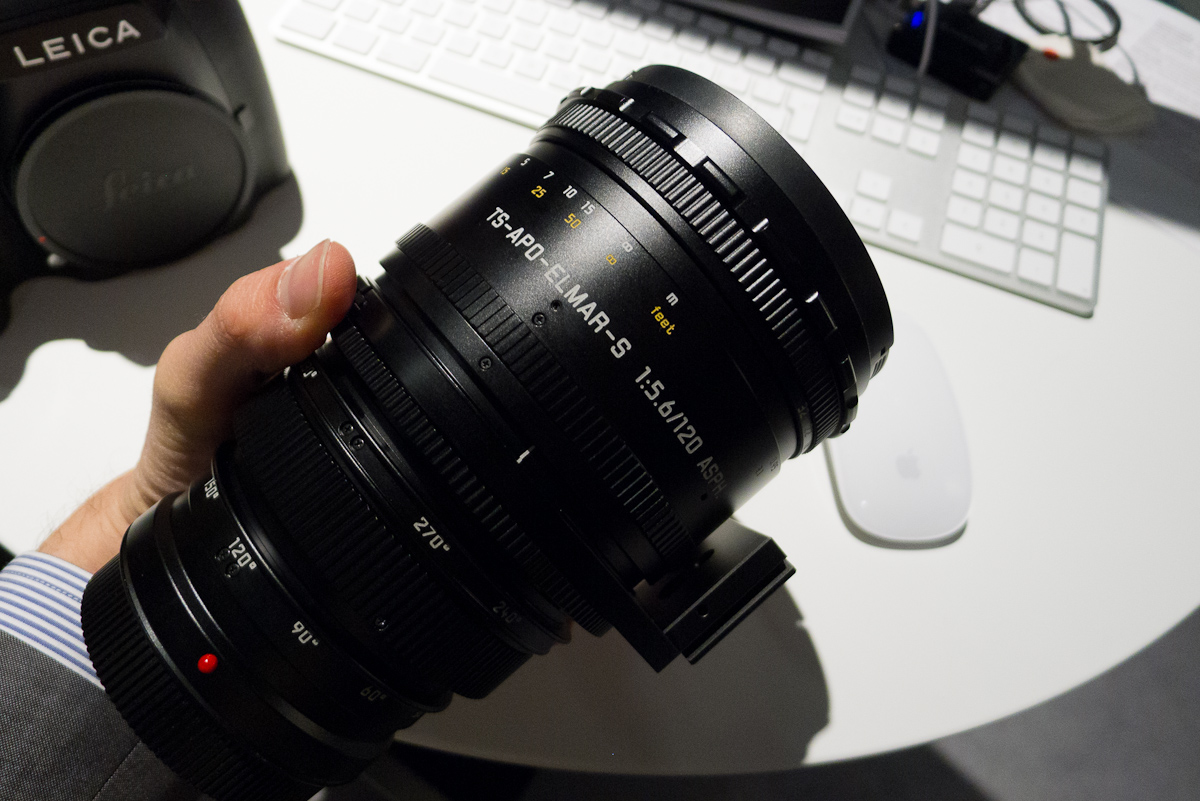
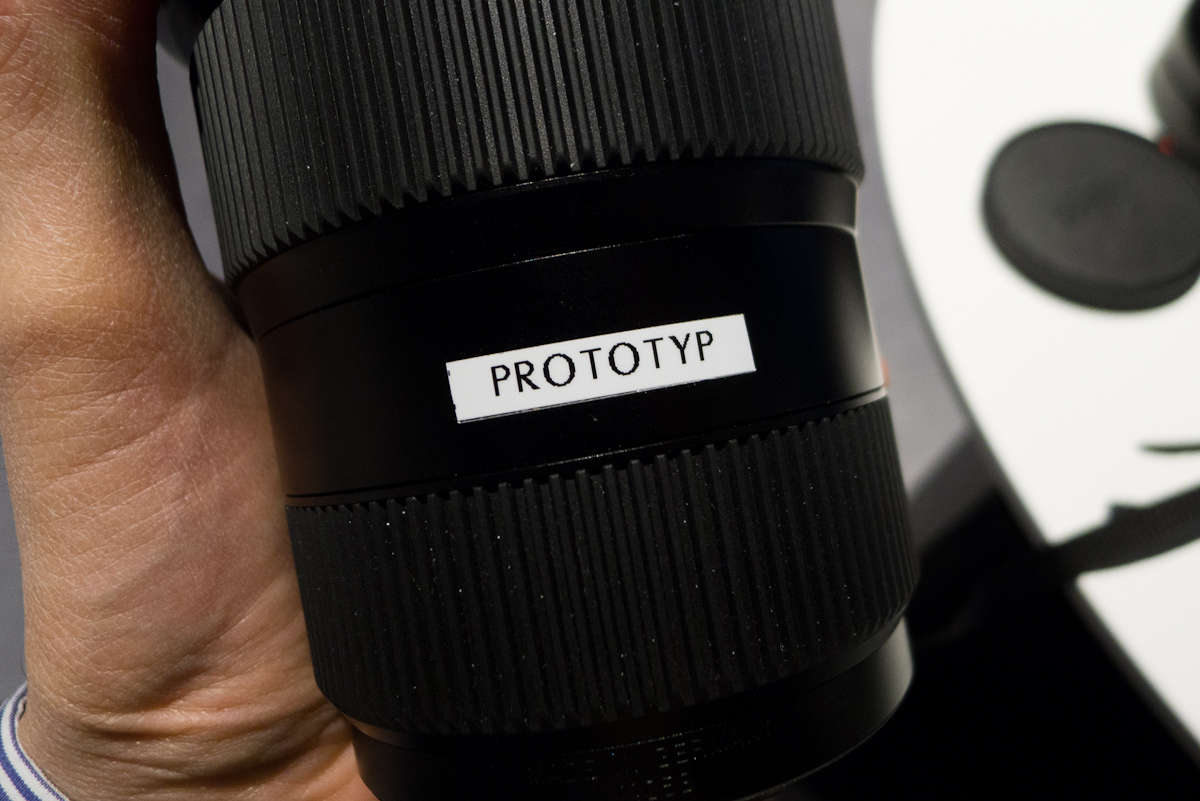
After a full rundown of the changes on the new Leica S camera which I covered in Part 1, I wanted to delve into the three new S lenses. Clearly, the announcement of the 30-90mm and the 24mm came as no surprise to anyone. Leica has been sharing the basic specs for some time now. The 120mm TS-APO-Elmar-S f/5.6 ASPH is a little different story, which is somewhat of a surprise. The lens might look familiar as it is the same excellent tilt-shift macro designed by Schneider Optics. Originally released in Mamiya mount for use on Phase One cameras, we found this lens worked well on the S2 with Leica’s M645 to S adapter. Really, the lens is most useful for table-top photography given its longer focal length. Still, having the lens in native S mount, covered under Leica warranty is not a bad thing at all. Just remember, the lens is manual focus and not weather sealed. This also wouldn’t be the first time that Leica has collaborated with Schneider on lenses. The legendary 15mm f/2.8 ASPH in R mount is a Schneider design.
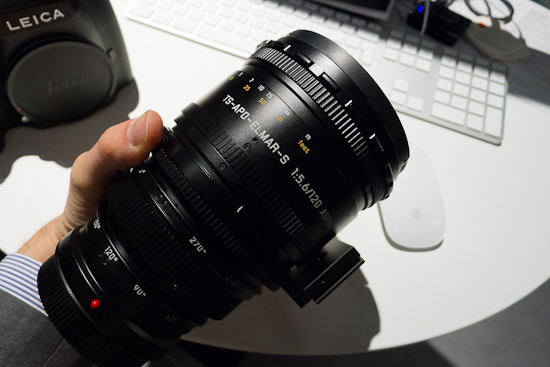
APO-TS-Elmar-S 120mm f/5.6 ASPH – Tilt-Shift for tabletop
The real story in my opinion are the 24 and 30-90, which really round out the S lens line-up nicely.
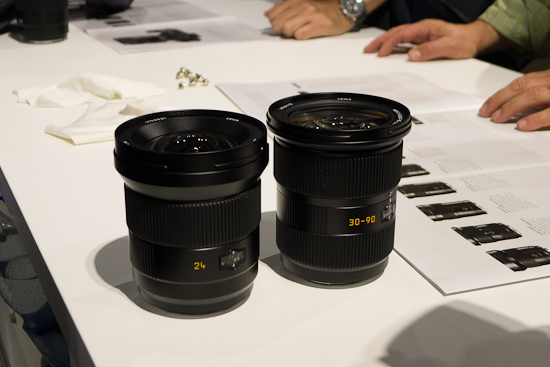
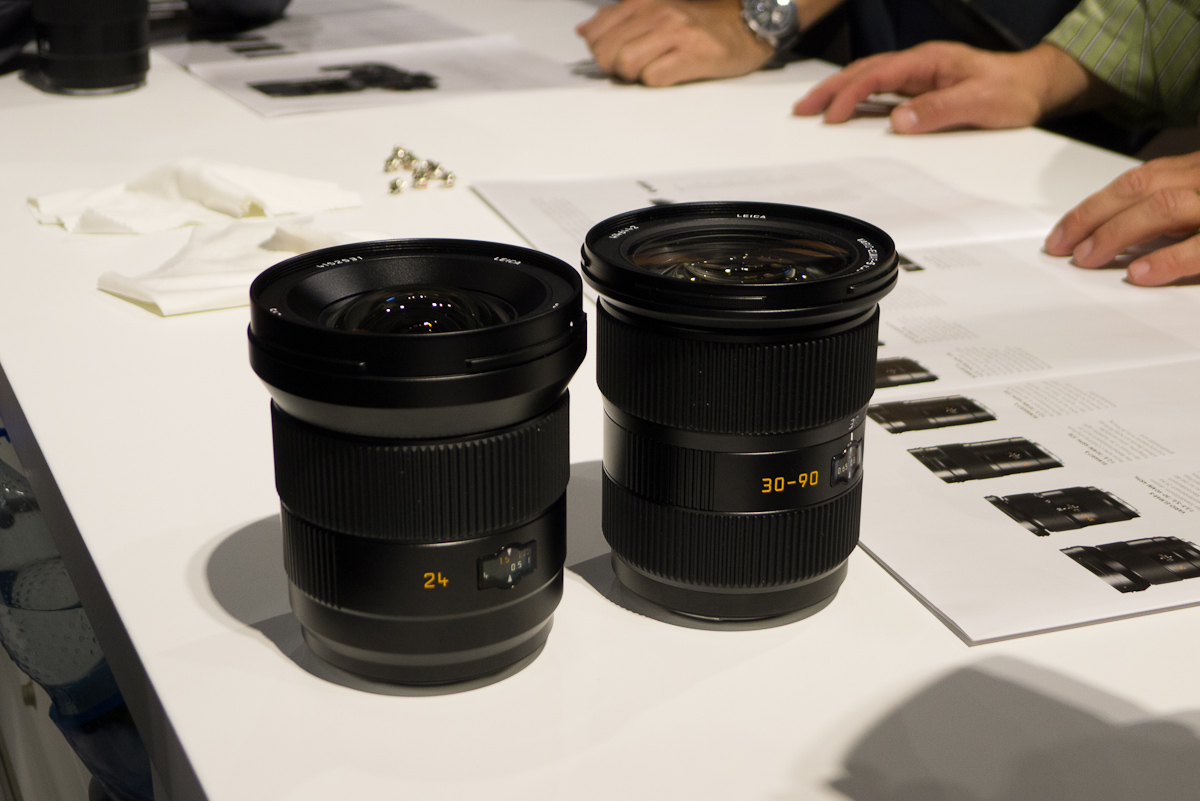
The 24mm Super-Elmar-S ASPH is extremely compact and offers a relatively fast aperture of f/3.5, just a half stop slower than f/2.8. It handles great and according to everyone I talked to in the Leica booth, is quite the performer. Peter Karbe, the head of optics for Leica, believes this lens sets a new benchmark for wide angle lenses in medium format. Distortion is extremely low and fully correctable in LR. Sharpness is outstanding. There is no shortage of exotic glass here – 12 elements in 10 groups, five of which have anomalous partial dispersion, three made from fluoride glass for CA control and three aspherical surfaces. And, by using a floating element design, performance from close focus to infinity is maintained. This lens is going to be phenomenal for interiors, architecture and landscape.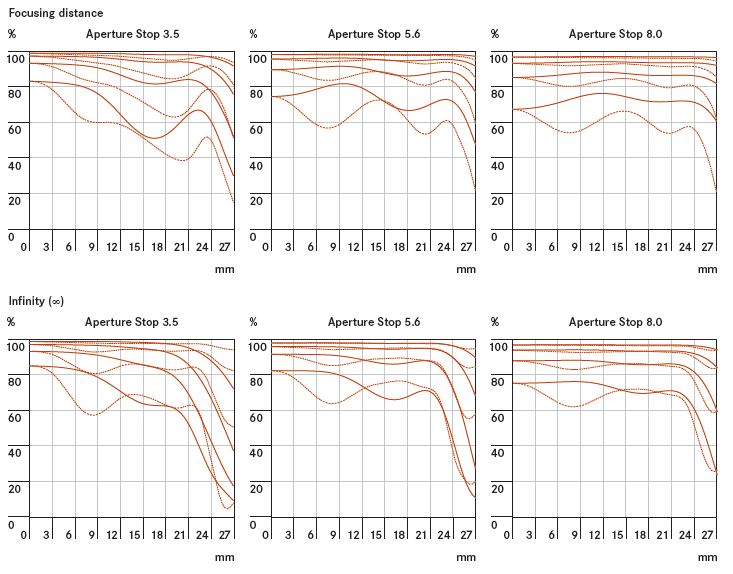
MTF for 24mm
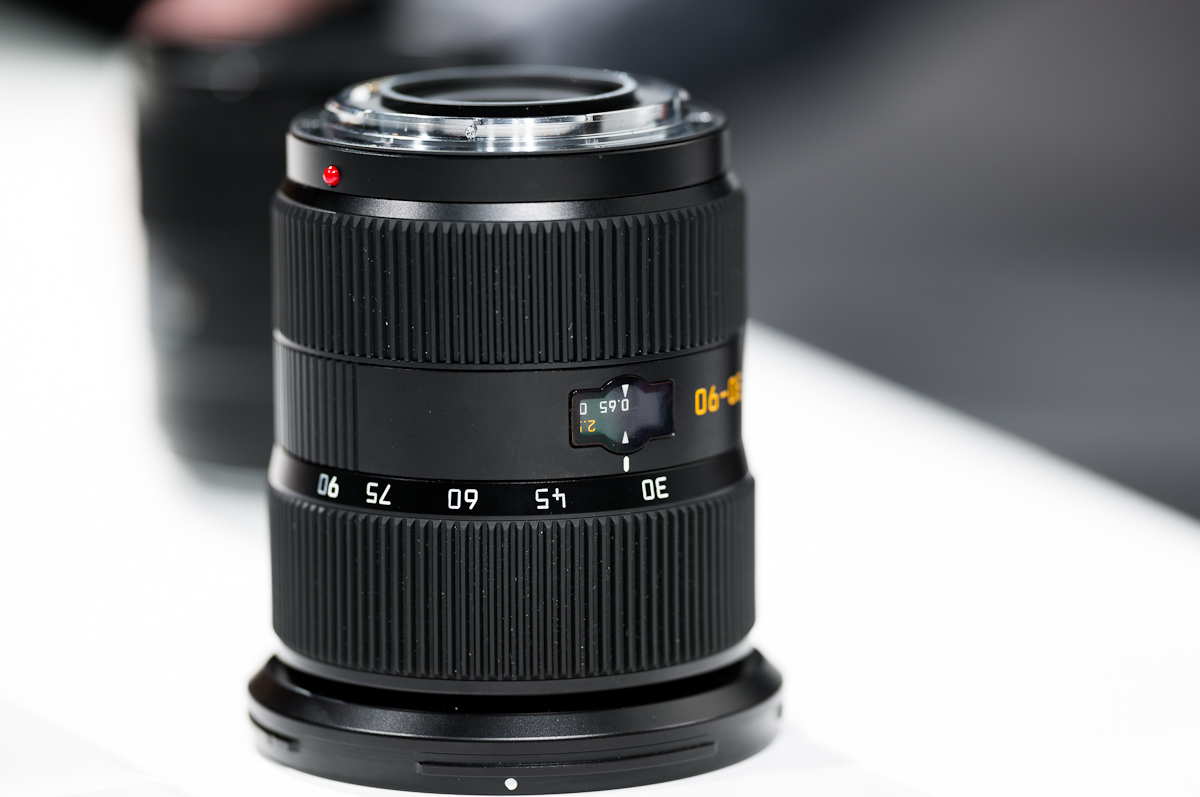
Since the S System came out, everyone has been lusting for the 30-90mm Vario-Elmar-S ASPH zoom. Well, after around two years in development, it’s here. And, it’s worth the wait.
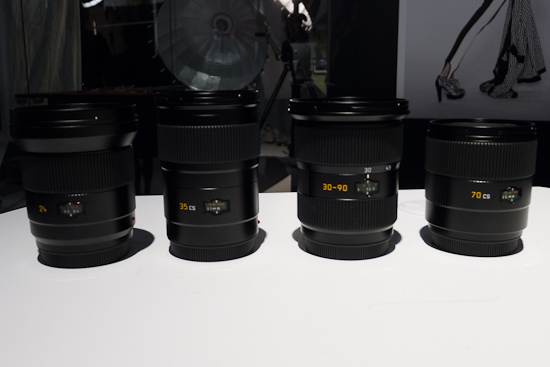
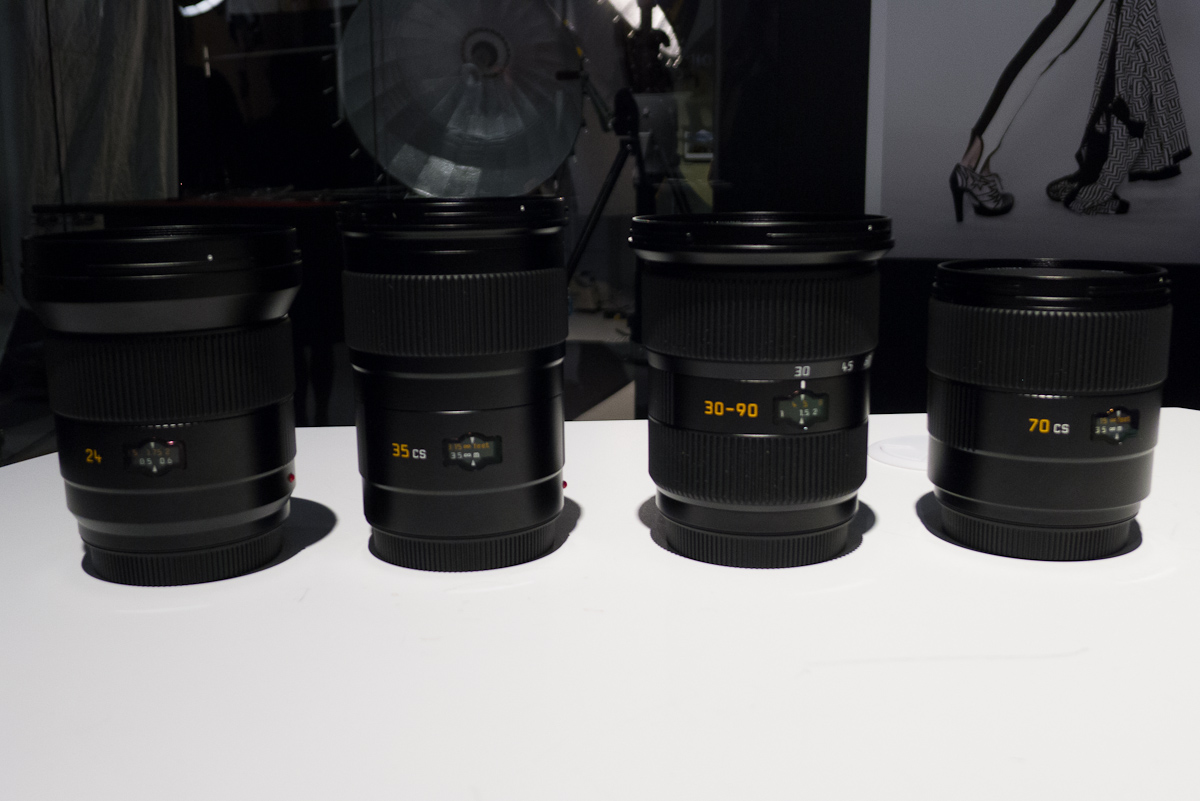
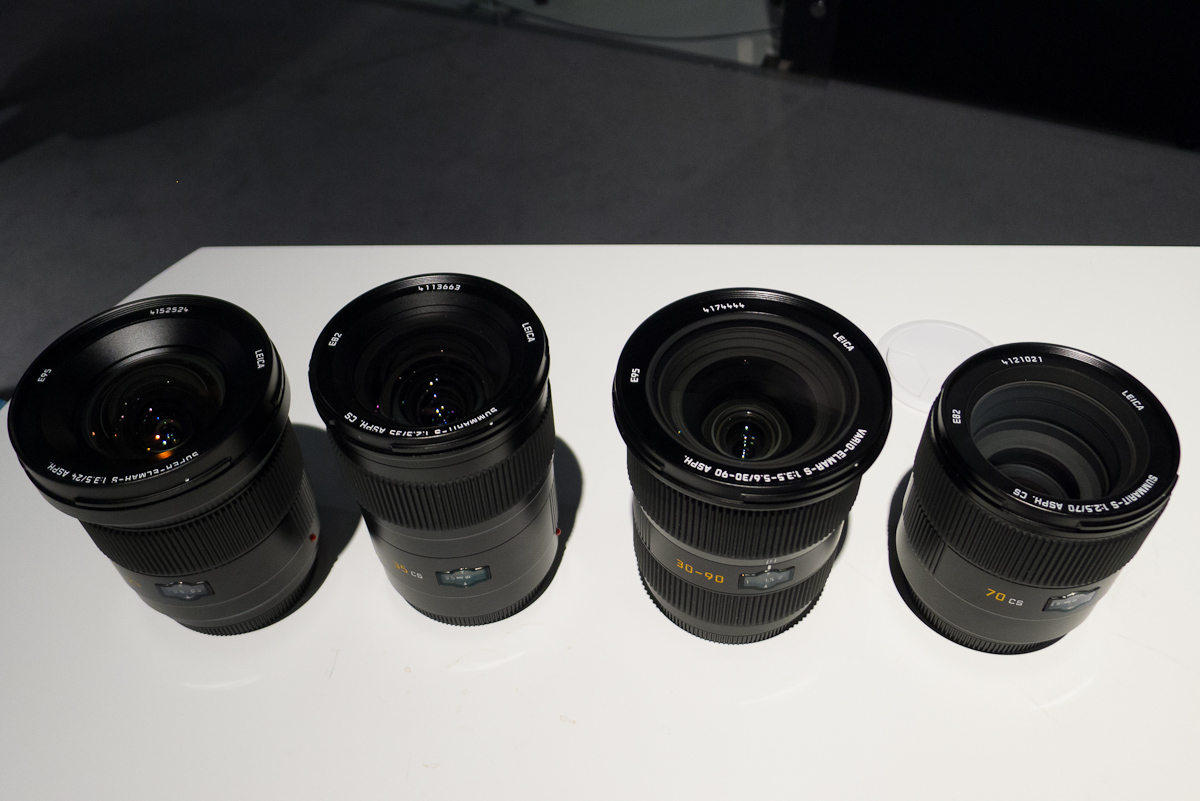
New lenses along side 35mm and 70mm for scale
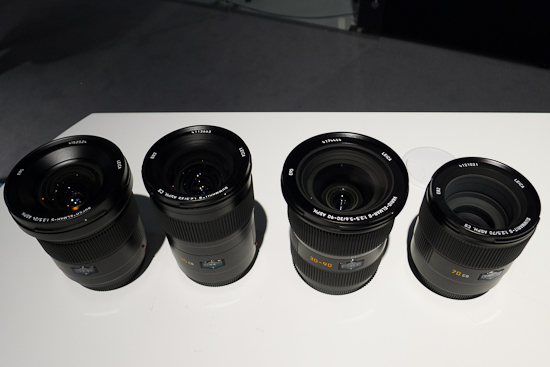
New lenses along side 35mm and 70mm for scale
Much smaller and lighter than I expected, the zoom is completely usable and portable. It is much, much smaller and lighter than the Hasselblad HCD 35-90 f/4.5-5.6, while sporting a wider zoom range and faster maximum aperture. Oh, yeah, and the Leica is also fully weather sealed just like the rest of the S lens line.
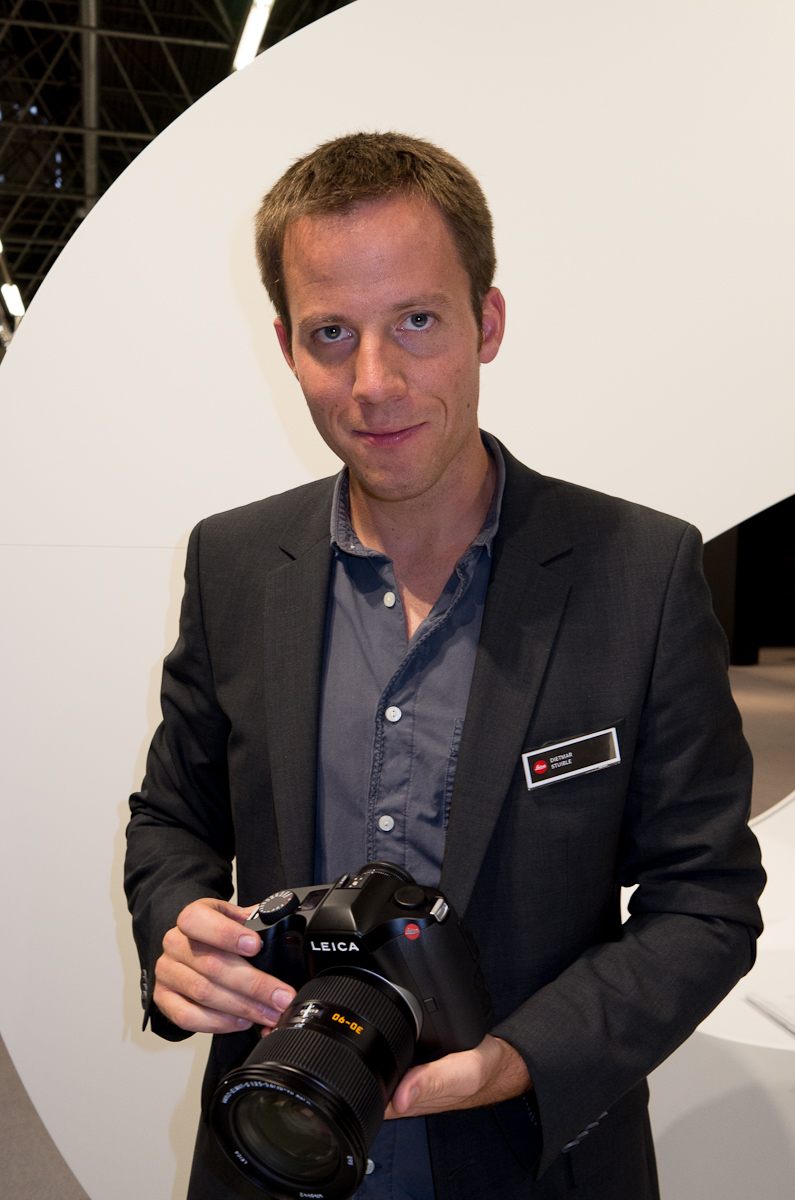
As with any zoom, there are some compromises versus fixed primes. I spoke with Dietmar Stuible, the optical designer of the new lens, who said that while it may appear simple to design a “normal” range zoom, the reality is that is actually extremely challenging to go from wide angle (24mm equiv) to short tele (90mm equiv) and maintain S-quality optical performance. So, the best compromise is to optimize for the middle range, where the lens will see the most use. Here, that is from 45 to 75mm.
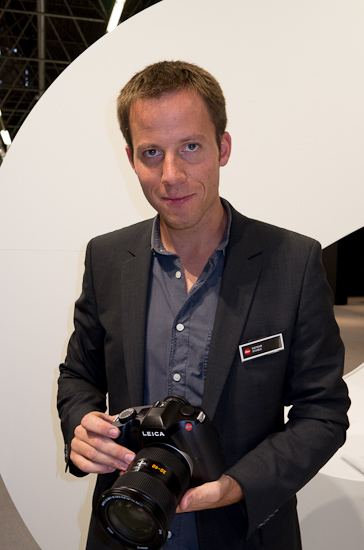
Dietmar Stuible – designer of 30-90mm
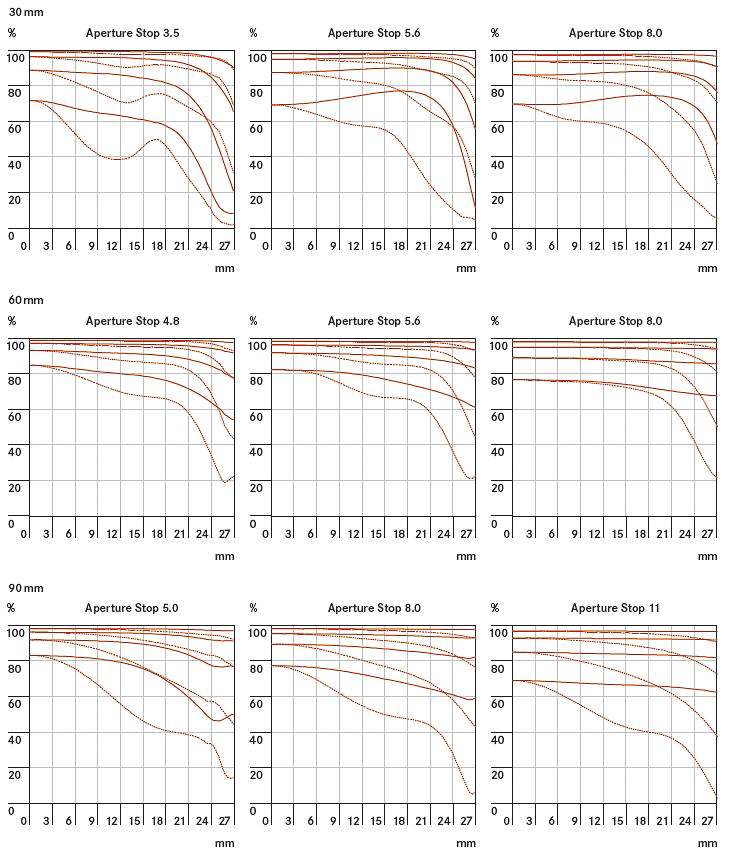
Of, course, this doesn’t mean that the lens is bad in the wide angle range. Quite the contrary, actually. We are talking about resolving 70% contrast for 40lp at 30mm, its “weakest” point in the zoom range. Yeah, not too shabby. Looking at the MTF of the zoom versus the fixed 30mm Elmarit-S ASPH, the MTFs look strikingly similar. At 60mm, the MTF is almost perfect , resolving over 80% contrast wide open for 40lp. The bottom line is that this is a real S lens. Also featuring quite an exotic design, the Vario-Elmar uses 14 elements in 4 groups, of which 9 have anomalous partial dispersion, three fluoride glass elements and three aspherical surfaces.
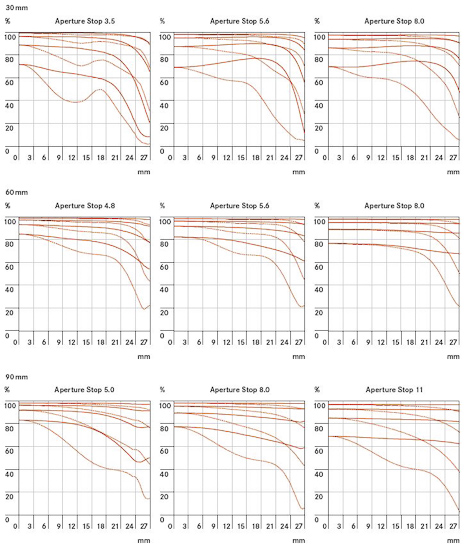
MTF for 30-90
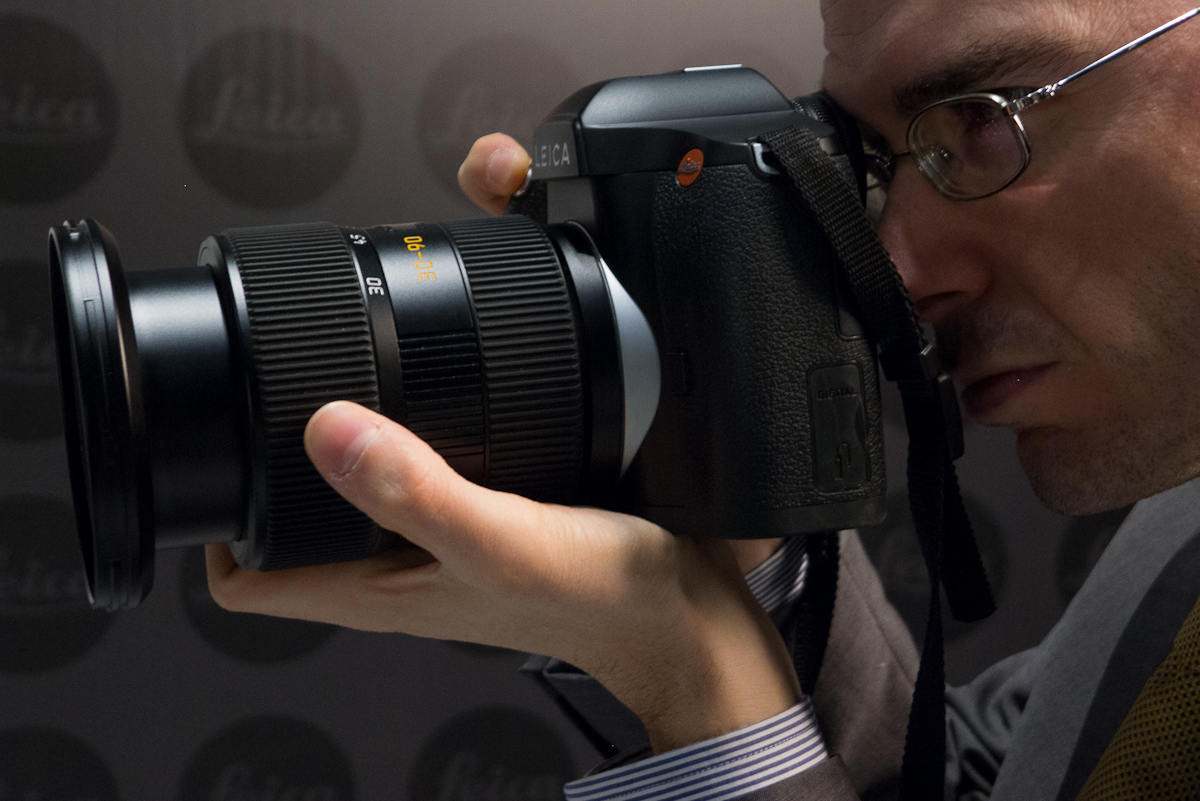
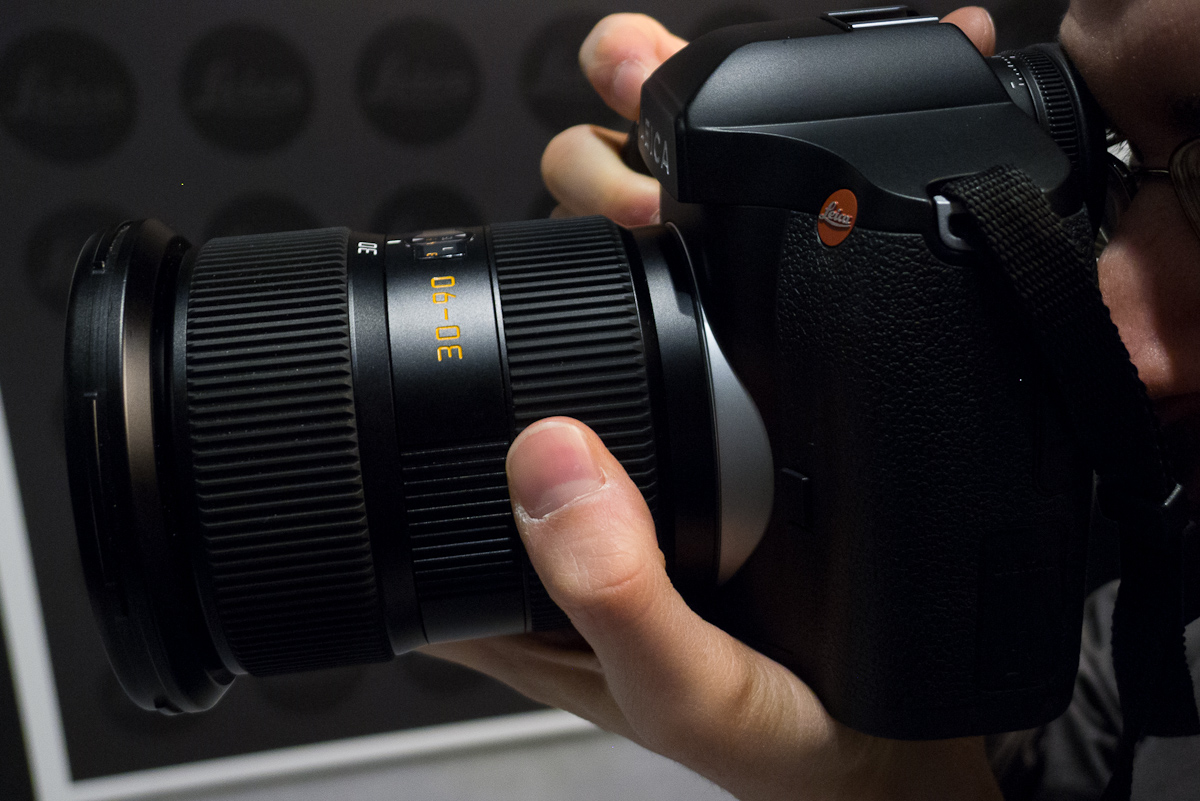
When you hold the lens, you wouldn’t know that you’re moving all that glass around. Zooming, even on the pre-production model, was very smooth with just the right amount of drag on the zoom ring. Leica placed the zoom ring forward of the focus ring where it falls right in between your thumb and forefinger. The rear-placed focus ring is still easily workable by sliding your hand back a few inches. The decision was made to go this way for two reasons. First, this approach was much easier from a mechanical perspective. Secondly, users will spend more time zooming that using manual focus. After, all, the S is an autofocus system. The lens, while shorter in length than the fixed 35mm Summarit-S ASPH, does extend several inches when zooming all the way to 90mm. In spite of the exposed tube, it is still fully weather sealed.
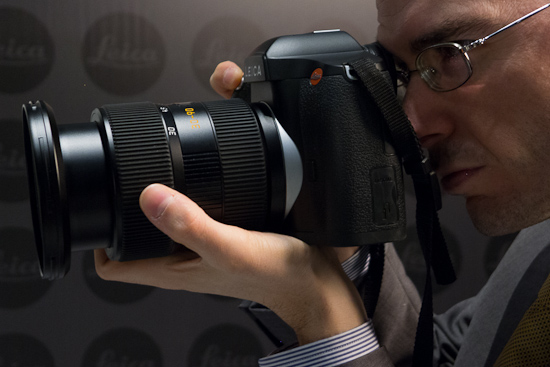
Zoom ring placement is perfect
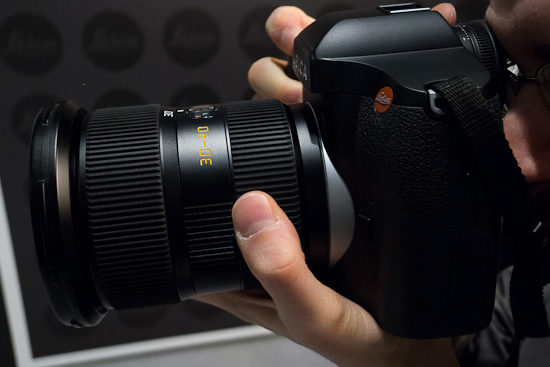
Focus ring is easy to work as well
For me, the real use of this lens isn’t to replace the fixed primes. A 70mm still offers a much faster aperture of f/2.5 in a lighter package. Where the zoom appeals to me is for tripod mounted landscape work. Not having to change a lens and being able to leave on my Schneider 4” filter set, while being able to change my perspective is huge. Less lens changes mean less times I have to dig into my backpack, less times shuffling filters, less exposure of the sensor to dust and moisture in the field and, ultimately, less break in the flow of shooting.
Both new lenses use 95mm filter size. According to Dietmar, the wider filter ring should allow the use of standard filter rings without any vignetting. I will be keen to try this with my Schneider 4” filter rig, which has a lot more depth than a polarizer.
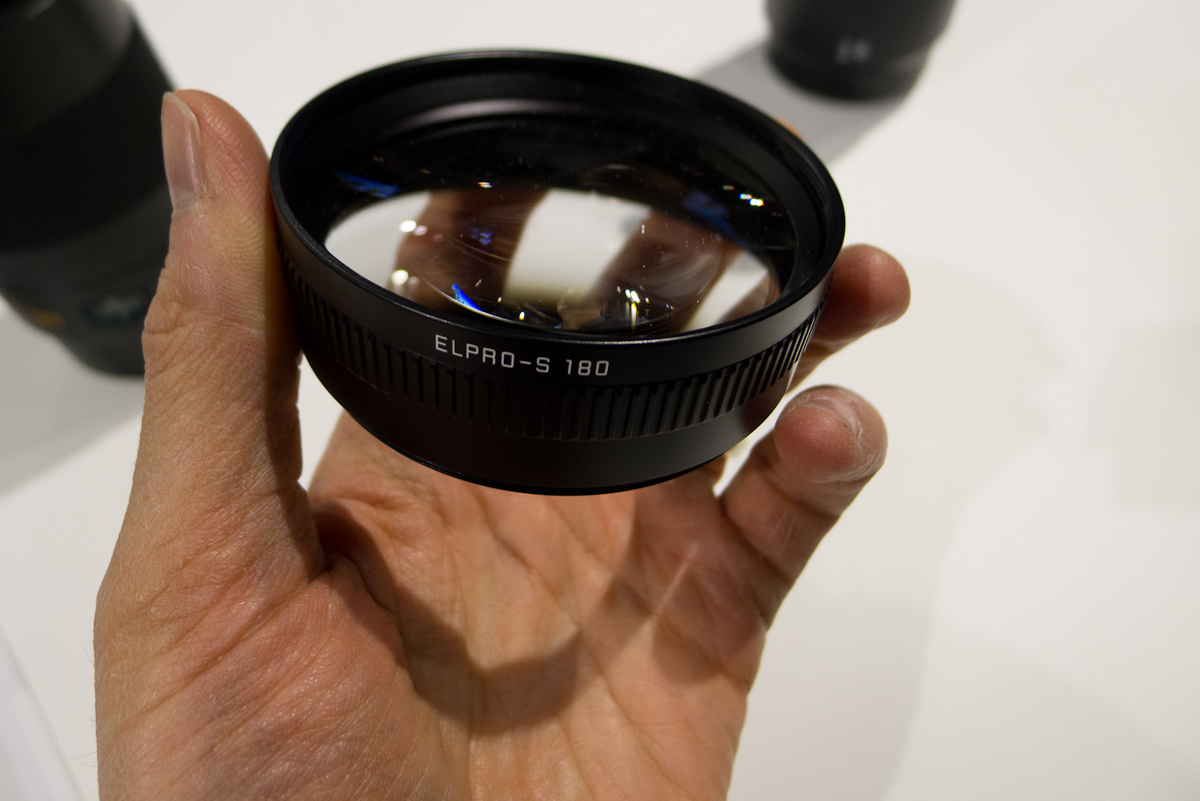
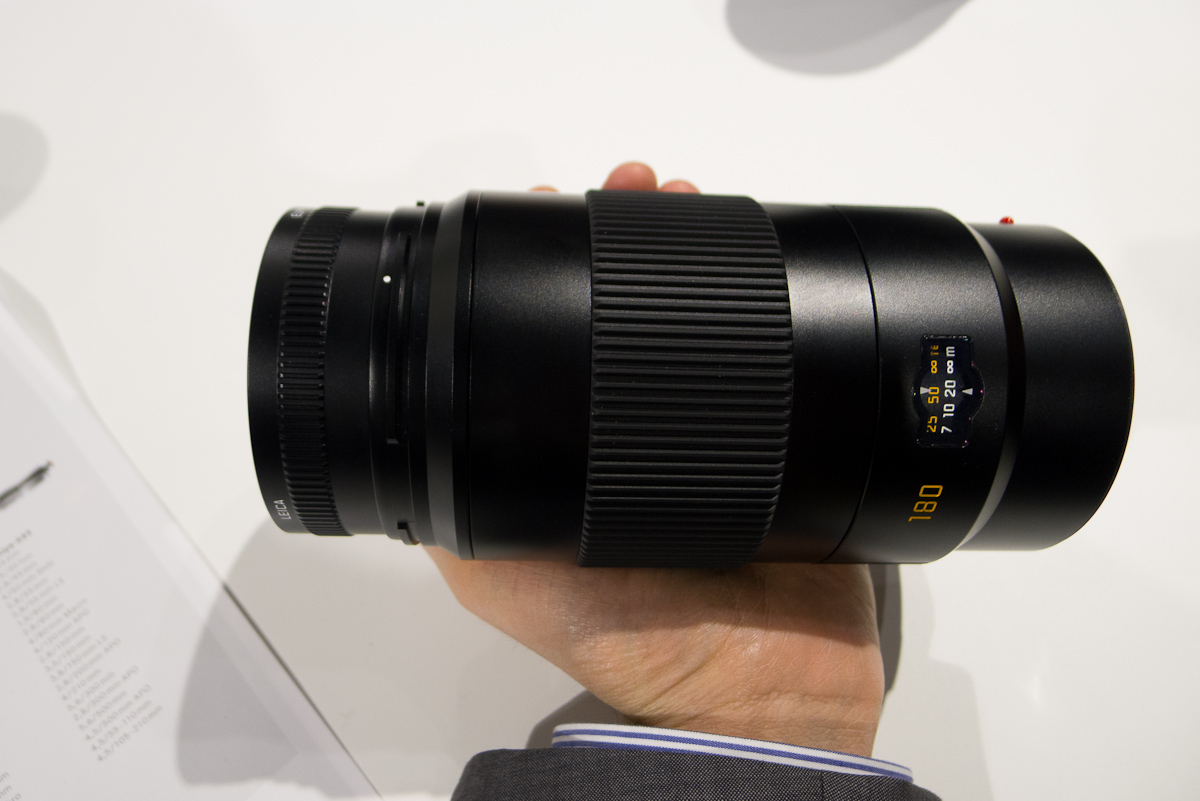
In addition to the lenses, Leica also showed an Elpro close-up adapter for the APO-Tele-Elmar-S 180mm f/3.5. My only gripe about the 180 – it is perhaps the most perfect of the S lenses, after all – is that the close focus just isn’t that close. Leica has answered the call on this one with the Elpro-S 180mm. Just screw the optical adapter on the front of the 180mm and you can now focus your 180 down to 3.6 feet for a reproduction ratio of 1:4.5. Not too shabby. I see this as of real use in fashion and beauty photography as well as adding flexibility while out in the field for landscape and general travel photography. You can carry just the 180 but have near-macro capability without the 120mm. Keep in mind, though, that with the Elpro attached, the camera will not focus to infinity. With a maximum focus distance of 8.8 ft, you won’t just be able to leave it on all day for walk-about photography. Here, the 120mm APO-Macro has a leg up in flexibility. Also impressive is that quality is not degraded at all and neither is exposure. There is no light loss with the adapter as there would be with an extension tube.
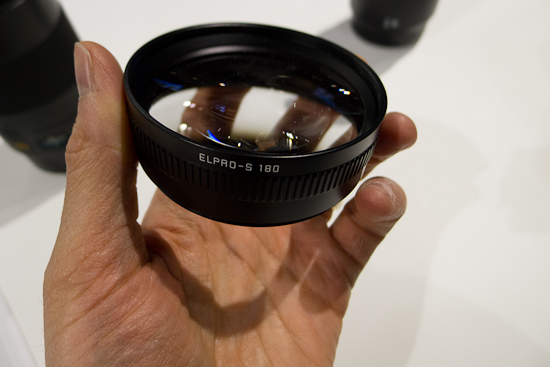
Elpro-S 180mm
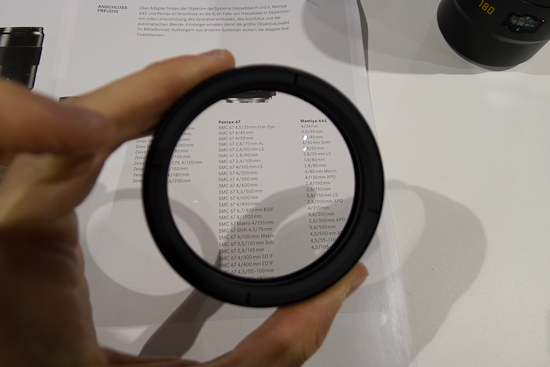
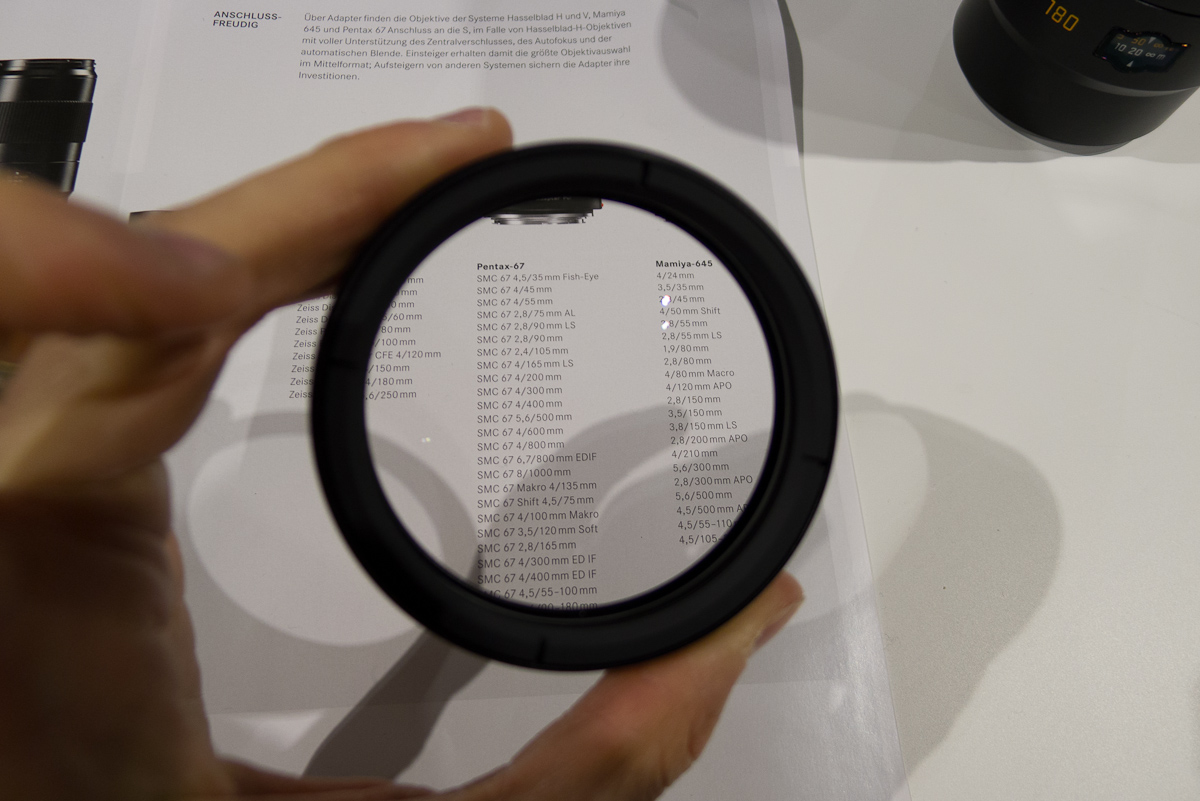
The Elpro makes a nice reading loupe as well….
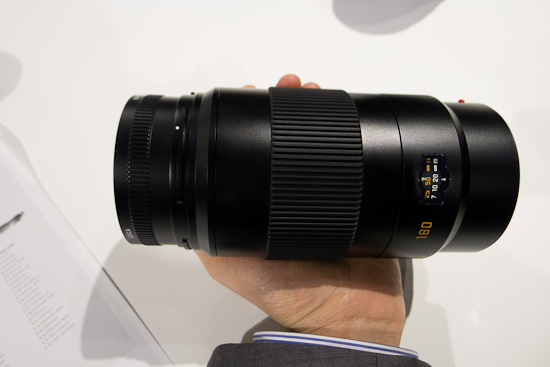
Elpro-S mounted on 180mm APO-Elmar
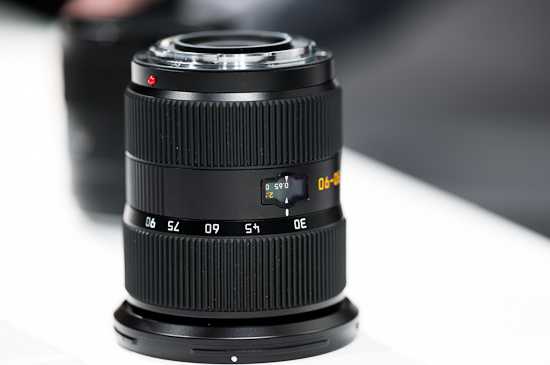
180mm with Elpro at minimum focus distance on S2
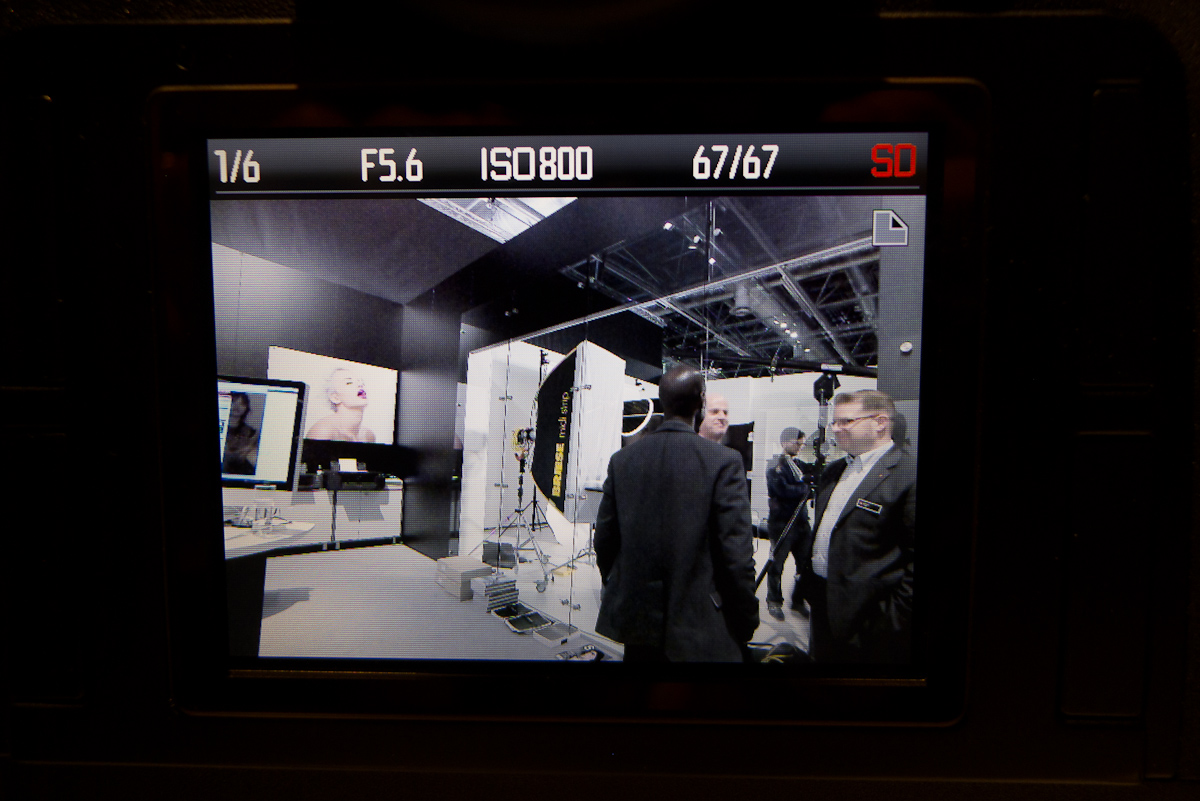
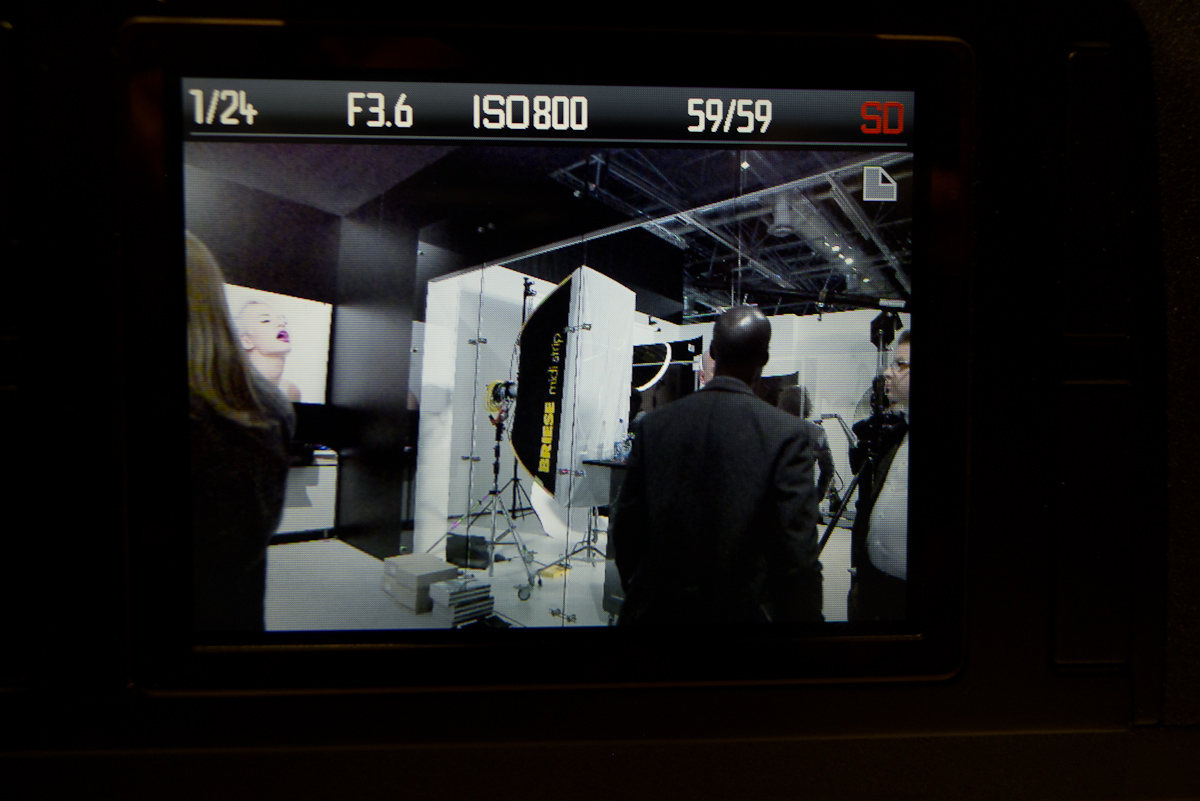
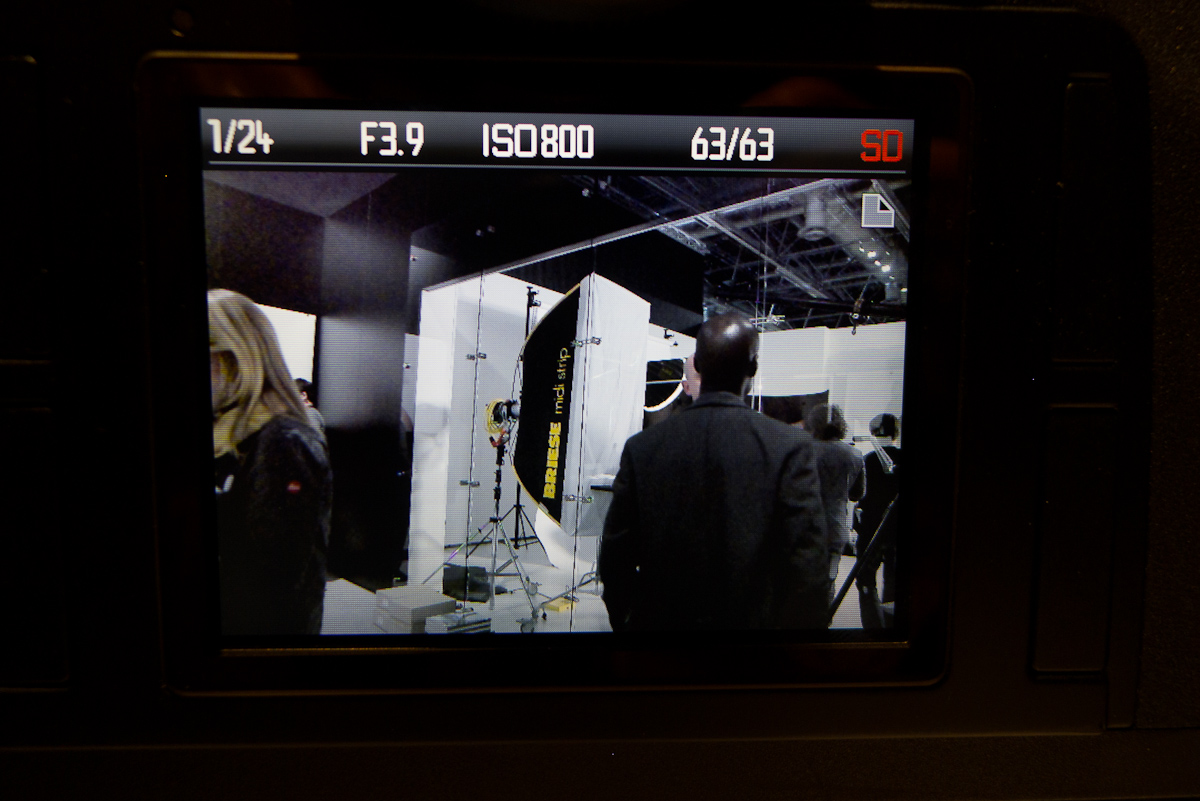
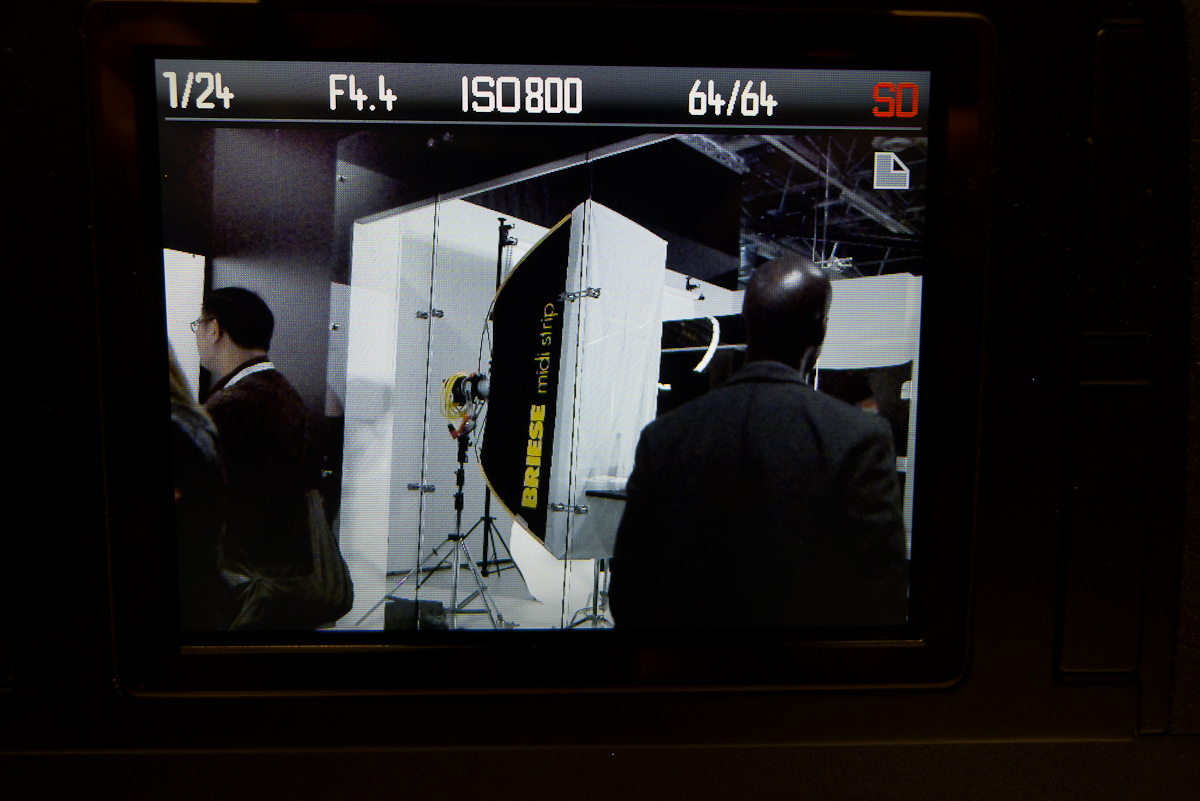
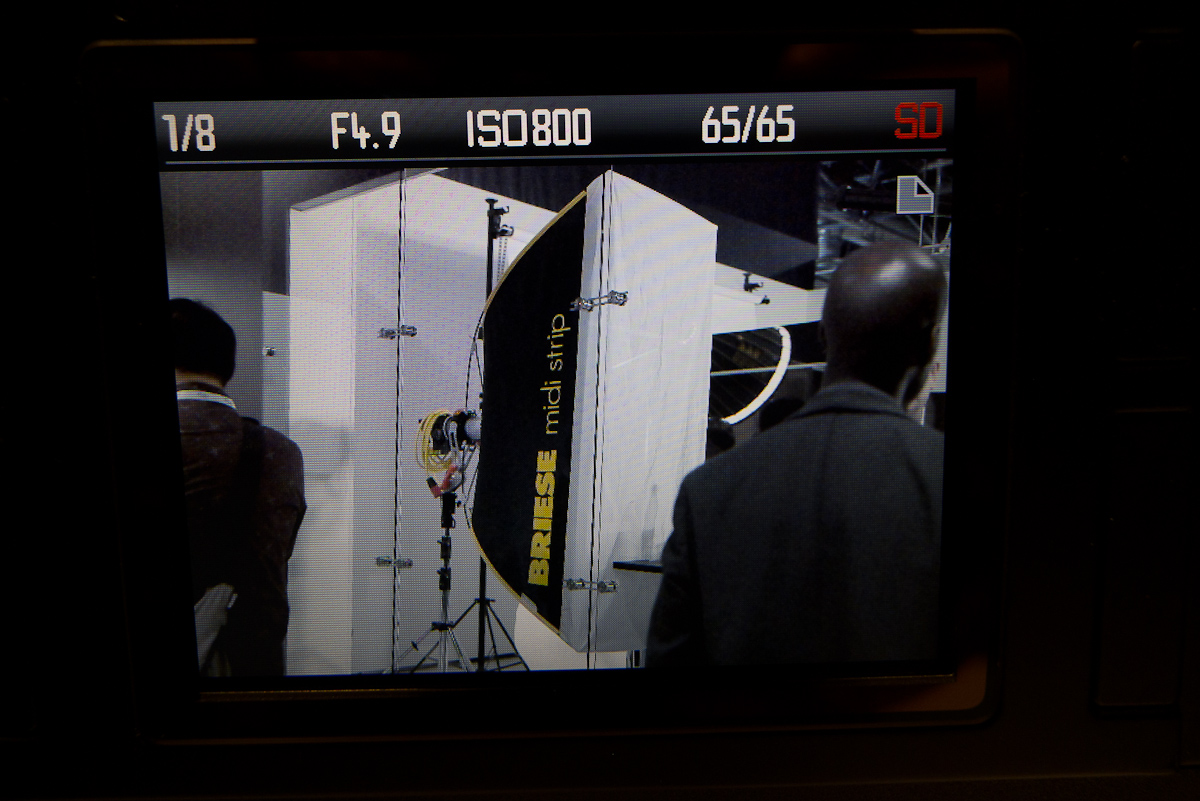
Finally, I’ve gotten questions related to the field of view range with the new lenses. While I wasn’t allowed to take sample shots as the models at the show were prototypes, I was allowed to shoot a sequence on a demo S camera and photographed the LCD to give an idea of relative angle of view.
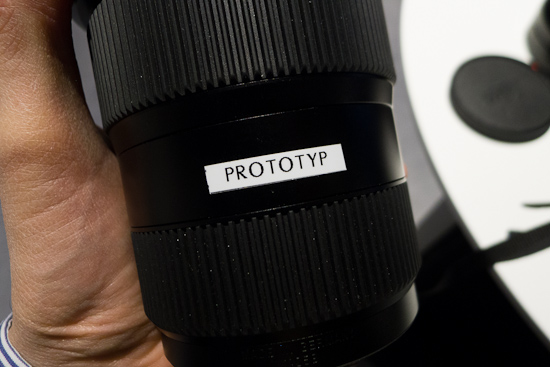
No sample images for me 🙁
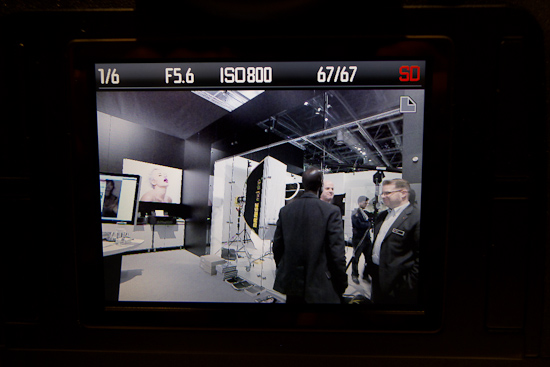
24mm Elmar – much wider!!
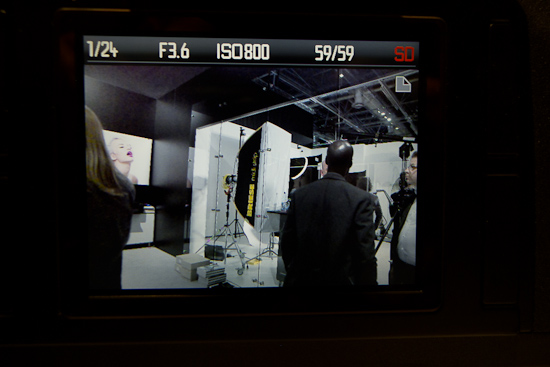
30-90mm Zoom @ 30mm
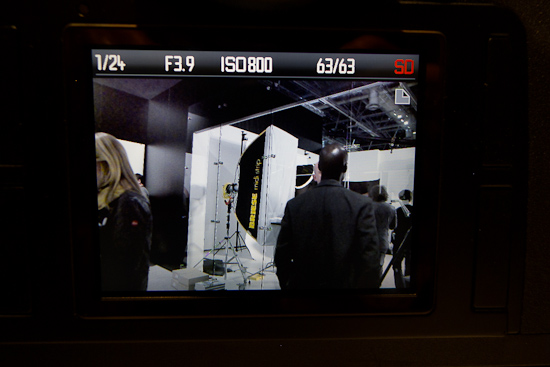
30-90mm Zoom @ 35mm
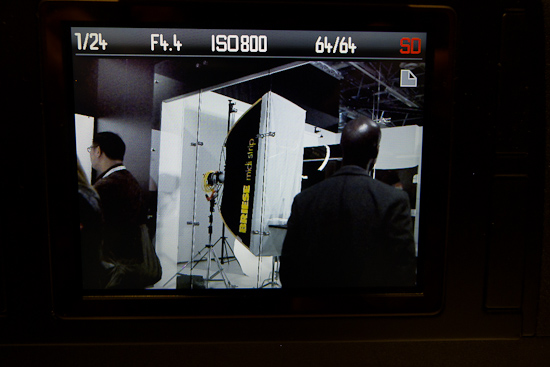
30-90mm Zoom @ 60mm
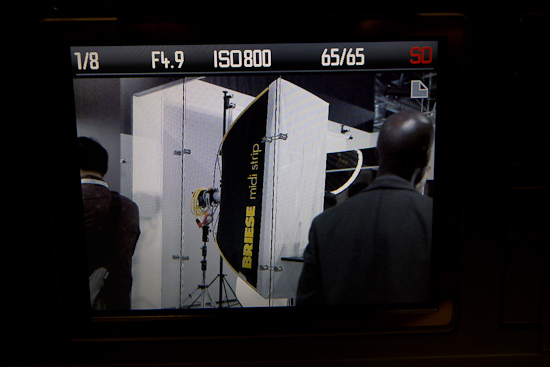
30-90mm Zoom @ 90mm
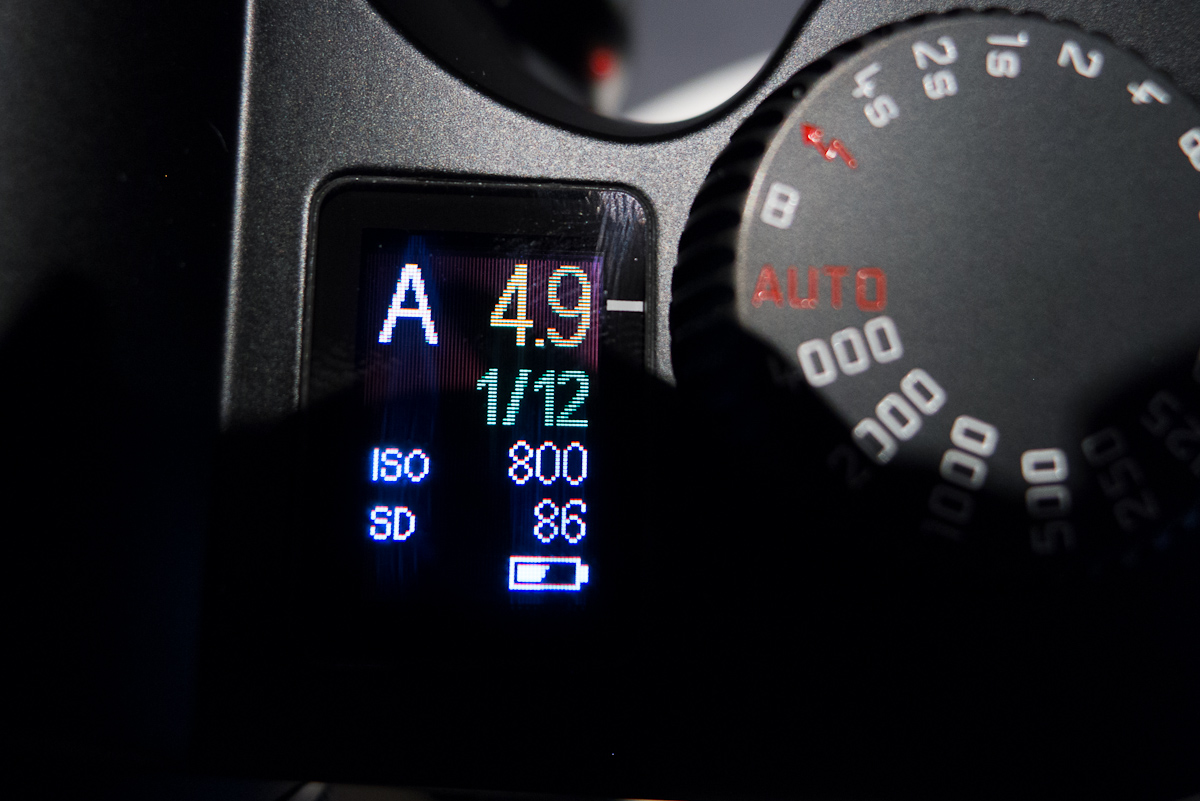
What I found was really fascinating was that the exact focal length and aperture were displayed on the LCD. So, even though there is no 35mm marking on the lens, I was able to use the camera to tell me where the correct zoom position was. Cool feature that eliminates guesswork. The aperture is accurately displayed in 1/10 f-stops. Also nice.
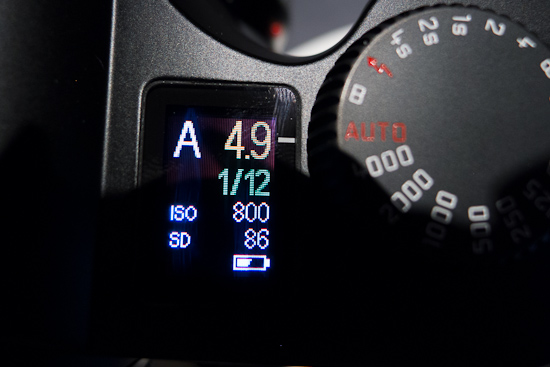
1/10th f-stop accuracy when zooming
That wraps up my S coverage for now. I will be interviewing S product manager Stephan Schulz in a couple hours and will most likely post the video when I return from Germany (painfully slow Internet does not like 1080p 30 minute YouTube uploads).
All of the new S lenses and the Elpro are available for pre-order from Leica Store Miami. The 24mm, 30-90mm and Elpro are expected to start shipping November 2012 and the TS 120 in January 2013.
-
Andrew replied to the topic And here we go. The NEW S2! in the forum Leica S (Typ 006) 13 years, 10 months ago
As we are at the question time, here are my questions:
– is technical feasible an upgrade of the S2 to some improvements introduced to the new S, and if so, which ones?
– when we'll be able to know how good is the new ISO 1600? Could be a new firmware capable of making the S2 reach the 1600 ISO?Thanks.
Andrew -
David Farkas replied to the topic And here we go. The NEW S2! in the forum Leica S (Typ 006) 13 years, 10 months ago
Mark Gowin;3219 wrote: Good point David. Reading your report of the S improvements reminded me of some conversations and requests I have made to the Leica staff.
Question, is focus bracketing an option in the new S? If not, then forewarn Stephan that I will be asking him about it again at PhotoPlus. 🙂
C'mon, Mark! If the new S had…[Read more]
-
Brian replied to the topic Any Monochrom deliveries yet? in the forum M Monochrom 13 years, 10 months ago
I posted this on the Leica forum- again, it is my personal speculation on the CCD used for the M Monochrom.
Low-noise, higher well-capacity (number of photons that can hit a pixel before it saturates), and better uniformity are all required for a better monochrome image. The M Monochrom goes to ISO 10,000 – meaning the noise floor was…[Read more]
-
Mark Gowin replied to the topic And here we go. The NEW S2! in the forum Leica S (Typ 006) 13 years, 10 months ago
Good point David. Reading your report of the S improvements reminded me of some conversations and requests I have made to the Leica staff.
Question, is focus bracketing an option in the new S? If not, then forewarn Stephan that I will be asking him about it again at PhotoPlus. 🙂
-
David Farkas replied to the topic And here we go. The NEW S2! in the forum Leica S (Typ 006) 13 years, 10 months ago
Pete Walentin;3213 wrote: I must add here, after reading Davids report, that Leica has really listened to what we discussed here and asked for. Thanks Leica.
Pete,
I feel the same way. Very few companies pay such close attention to the requests and issues of its users. The M9 was created, in large part, from an Internet poll of features…[Read more]
-
Pete Walentin replied to the topic And here we go. The NEW S2! in the forum Leica S (Typ 006) 13 years, 10 months ago
I must add here, after reading Davids report, that Leica has really listened to what we discussed here and asked for. Thanks Leica.
-
David Farkas replied to the topic And here we go. The NEW S2! in the forum Leica S (Typ 006) 13 years, 10 months ago
Guys, I updated the article with a few corrections, feature additions and more images. Check out the article (again) for more accurate info.
-
Pete Walentin replied to the topic And here we go. The NEW S2! in the forum Leica S (Typ 006) 13 years, 10 months ago
Hey… pretty cool report. Thanks.
It is much more what I discovered during my hands-on and I have to admit while reading the details I thought that I would love to have this camera. But as another new toy arrived in my hands today I have to wait… 😉
-
PebblePlace replied to the topic And here we go. The NEW S2! in the forum Leica S (Typ 006) 13 years, 10 months ago
Lots of good info there – Thank you. I'm looking forward to seeing some specifics on the sensor performance. Do you know if LR will have an update for new S?
-
David Farkas replied to the topic And here we go. The NEW S2! in the forum Leica S (Typ 006) 13 years, 10 months ago
Roger;3200 wrote: Pete
Very nice report . Looks like you are enjoying yourself ..I am jealous !
David
So the sensor is the same (formerly Kodak ) CCD ? This is good and bad …the IQ should match the near perfect S2 (no problem in interchanging bodies on a shoot) but it also limits the possible improvement in high ISO to…
-
stephan replied to the topic Any Monochrom deliveries yet? in the forum M Monochrom 13 years, 10 months ago
I will get mine tomorrow. I will not cancel my order for the new M, as from the specifications it should be better than the M (without the color option, of course)
-
Roger replied to the topic And here we go. The NEW S2! in the forum Leica S (Typ 006) 13 years, 10 months ago
Pete
Very nice report . Looks like you are enjoying yourself ..I am jealous !
David
So the sensor is the same (formerly Kodak ) CCD ? This is good and bad …the IQ should match the near perfect S2 (no problem in interchanging bodies on a shoot) but it also limits the possible improvement in high ISO to what can be…[Read more]
- Load More