-
Mark Gowin replied to the topic Discardia: old ruins of a brewery in the forum Images to Share 14 years, 2 months ago
Jack,
Thank you for the explanation. Your reasoning makes sense. I may have taken multiple shots of each position to allow focus stacking in post. However, your approach may be more pleasing to the eye.
-
Mark Gowin replied to the topic Marcus Tedeskino with S2 and CS lenses in the forum S2 14 years, 2 months ago
Surely, the wait won't be much longer. The video showed a good example of why you might want the 35mm in the CS variety. That is probably the last of the lenses I would have considered for a CS application. Then again, I don't photography people very often so what do I know.
-

David Farkas replied to the topic Suggestions for feature additions in future S2 firmware updates in the forum S2 14 years, 2 months ago
stephan;2423 wrote: I had no lock up either since then, so maybe it was something else.
Nevertheless, I have two other wishes for an eventual firmware-update:
1) Since the last firmware update, it appears that the lens goes back in the last position after shutting down the camera. What may look as a good idea first, brings some problems…
-
stephan replied to the topic Suggestions for feature additions in future S2 firmware updates in the forum S2 14 years, 2 months ago
I had no lock up either since then, so maybe it was something else.
Nevertheless, I have two other wishes for an eventual firmware-update:
1) Since the last firmware update, it appears that the lens goes back in the last position after shutting down the camera. What may look as a good idea first, brings some problems for me: I have…[Read more]
-

Jack MacD replied to the topic Discardia: old ruins of a brewery in the forum Images to Share 14 years, 2 months ago
Mark,
Glad you like them.
To answer your question of DOF, That diptych was shot with three 120mm images merged into a panorama, then reduced to a triptych then narrowed down to a diptych.
There was no focus stacking. I focused on the far wall, letting the foreground beams go soft. You can see the actual DOF in this close cropping of the…[Read more] -
Leica Store wrote a new post 14 years, 2 months ago
Today, Adobe has released the latest version of Lightroom: Adobe Lightroom 4.1. Most notable for Leica users is the added support of two recently announced Leica products, the Leica M Monochrom and Leica […]
-
Mark Gowin replied to the topic Discardia: old ruins of a brewery in the forum Images to Share 14 years, 2 months ago
Jack, thank you for posting your images and link to the TOP article. Both were very enjoyable. I am not sure which image I like the best each have their own merits. On one hand I like the colors and texture of the peeling paint on the drain pipe and the old weathered bricks. On the other, I like the grandness of the diptych or reflected…[Read more]
-
albireo_double replied to the topic S2 dead–any help appreciated in the forum S2 14 years, 2 months ago
Yup, I think I'll be getting a third battery just in case, before I leave for my Africa trip in a month's time…(got the vertical grip today; camera handles much better for me now, even for horizontal shots).
-
David K replied to the topic Discardia: old ruins of a brewery in the forum Images to Share 14 years, 2 months ago
Good to see you're out there shooting Jack. Very nice images and a great write up. Agree with David about the shot with the water…well seen.
-
David Farkas replied to the topic Leica Liker's Interview with Craig Semetko, Leica M9 Street Photographer in the forum Images to Share 14 years, 2 months ago
leica liker;2394 wrote: Hi Everyone:
I just posted an inspirational interview with Craig Semetko, Los Angeles Street Photographer, Leica user and Leica Akademie Weekend Guest Instructor, on my blog.Photo by Craig Semetko
Craig is a great guy and a wonderful photographer. I first met him in 2008 when he…[Read more]
-
David Farkas replied to the topic Discardia: old ruins of a brewery in the forum Images to Share 14 years, 2 months ago
Jack MacD;2410 wrote: A follow up to this shoot on TOP has Mike Johnson showing some of the same photos. Always interesting to see how iterations of resizing and downloading the same image may or may not change the presentation and color of a given…
-
Jack MacD replied to the topic Discardia: old ruins of a brewery in the forum Images to Share 14 years, 2 months ago
A follow up to this shoot on TOP has Mike Johnson showing some of the same photos. Always interesting to see how iterations of resizing and downloading the same image may or may not change the presentation and color of a given image.
-
GPLeica replied to the topic S2 dead–any help appreciated in the forum S2 14 years, 2 months ago
I am now going to make the time to participate in this forum. Having heavily used an S2 for nearly two years now, I'd have to agree that one of its weak links is the battery. I bought a second battery within a week, having experienced an initial problem of having had the camera in my bag overnight with a fully charged battery and went out to shoot…[Read more]
-
Paratom replied to the topic My Leica M Monochrom review is up! in the forum M Monochrom 14 years, 2 months ago
Thanks David for the interesting review about the M9M and the 50 APO.
I believe the images do have a special look. But I am not yet convinced that the difference is clear enough to convince me to dig in. I am also a bit “afraid” that I could regret buying a M9M after the M10 is announced.
While I am not yet decided about the M9M I am…[Read more]
-
ski542002 replied to the topic Leica M Monochrom in the forum M Monochrom 14 years, 2 months ago
My opinion; I'd hold off on a pre-owned M6 and put the funds towards the eventual M10. I'm enough of a purist to get into the M rangefinder system, but strongly feel that
going back to film will provide no technical, aesthetic, or professionally competitive edge. Especially to my last point, I strongly feel if you still shoot film, you will be…[Read more] -
Leica Store wrote a new post 14 years, 2 months ago
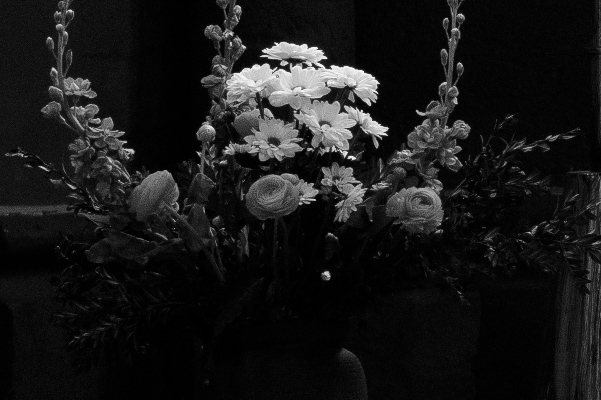
While I had the Leica M Monochrom for testing in Germany, I figured I'd do a quick semi-controlled ISO test compared to my M9. I had certain impressions of relative ISO performance during my review of the M Monochrom, but nothing beats a side-by-side test. Before we get into the comparisons, let me first explain my methodology.
Testing methodology
These images were taken in the Wetzlarer Dom while I waited for the rain to subside. I shot them sequentially using the same lens: the Leica APO-Summicron 50mm ASPH using the same aperture (f/5.6) and same focus point. Between camera tests, I swapped the bottom plate while still mounted on the tripod so there would be as little movement as possible. Exposure was carried out using aperture priority. The light didn't change inside the church (overcast and rainy outside) and theoretically both cameras have the exact same meter. My intention was to shoot as quickly as possible and run through the entire ISO range so there would be no change while testing. Ultimately, the exposures did remain consistent.
Post processing approachBoth the M Monochrom and M9 images were processed in LR4 with all images of the same camera receiving identical settings. The M Monochrom images and the M9 were processed slightly differently due to necessity (one is natively B&W, the other is not). Here, my intention was to match the M9 as closely as possible to the M Monochrom result in terms of B&W conversion. Did they match exactly? No. I think the M Monochrom still gave superior B&W images even with tweaking the M9, but I suppose this was to be expected.
I did apply sharpening to the files on both cameras, with the same settings for both. These are the settings I would normally use on either the M9 or the M Monochrom. I feel it is best to compare fully processed images that have been made to look as close to finished files as possible. I know that other testers use “out-of-camera” images with “nothing applied”, but I never quite understood this approach. Post processing is part of the normal workflow and, in my opinion, shouldn't be separated from the camera for testing purposes. It's sort of like track testing two cars with their tires removed (so as to not give any traction advantage). I want to see what my actual results will be when I shoot these cameras in a real-world situation, and in the real world I would never not process the files to my taste.
That said, I turned off all noise reduction on both cameras, with the exception of the ISO 5000 and 10000 tests of the M Monochrom. Here, I provided images with no NR applied and with minimal NR as I might apply based on subject matter.
To compare the images, you can drag the center slider handle left and right, single-click in the area you want to split the image, or just use click the text controls underneath. In all images up to 2500 ISO, the M9 is on the left and the M Monochrom is on the right. For 5000 and 10000, only M Monchrom images are shown, with the noise reduced version on the right. All samples are at 100% size (1 pixel on screen = 1 pixel from camera). Enjoy!
ISO 320
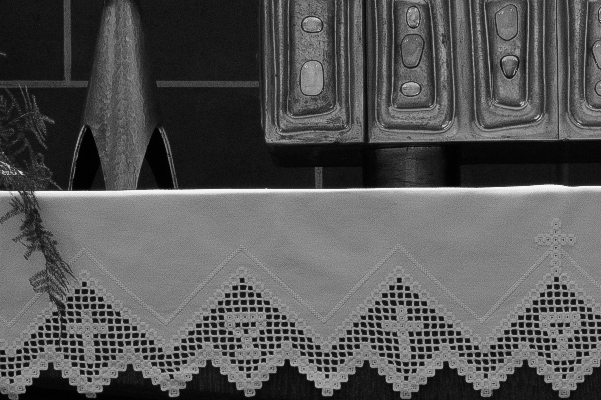
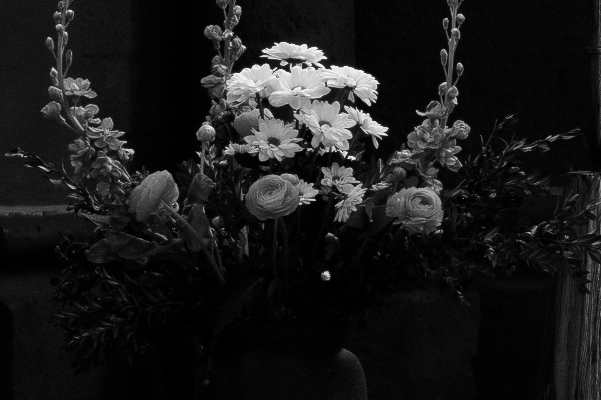
ISO 640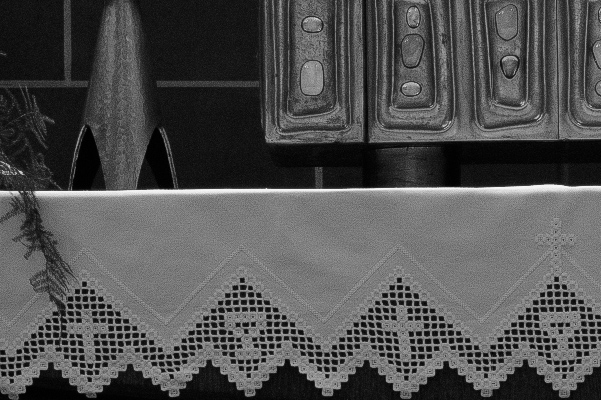
ISO 1250
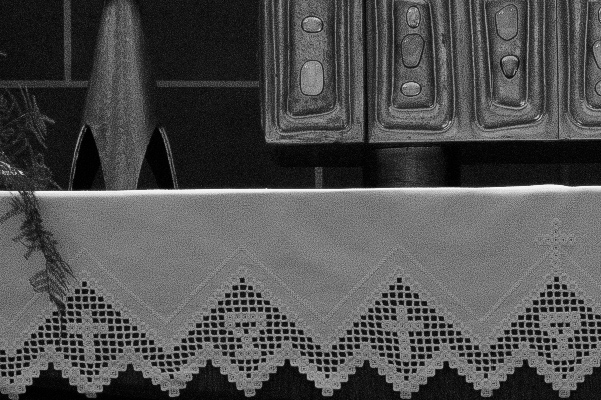
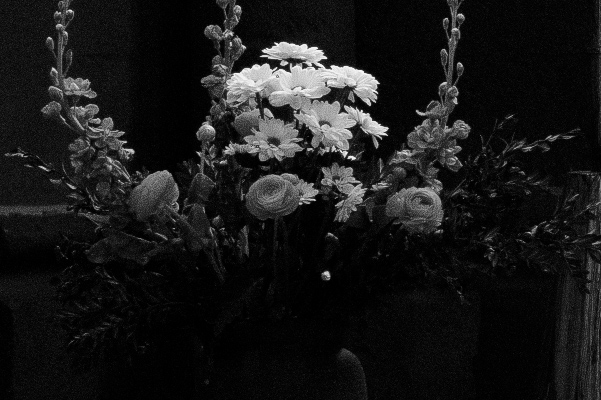
ISO 2500
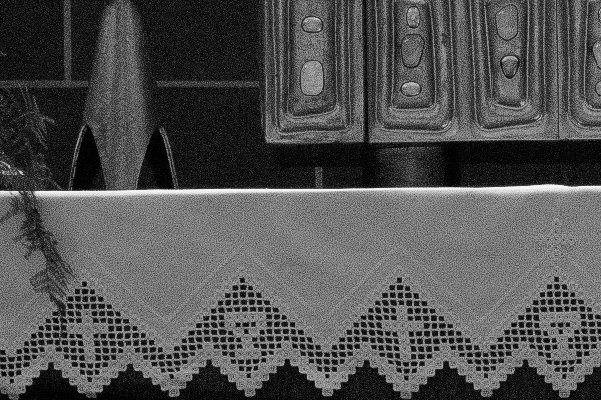
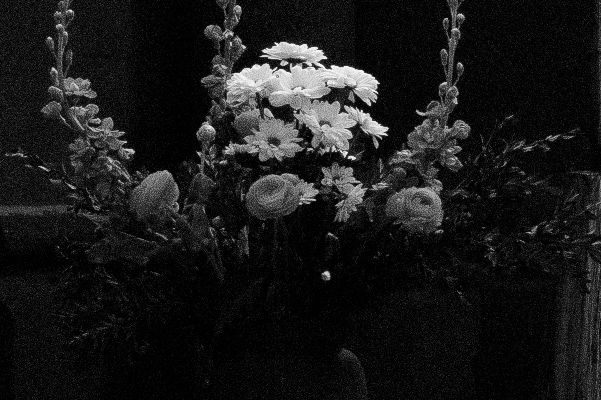
Because the M9 tops out at ISO 2500, the last two are M Monochrom only. As I mentioned in my full review, I think that noise reduction is only advisable after ISO 3200. I generally prefer to have more detail rather than totally smooth files.
ISO 5000
Here, I think noise reduction could be useful, but it's not necessary. On the left: no noise reduction. On the right: Luminance NR set to 20. For ISO 5000 and 6400, a little NR goes a long way.

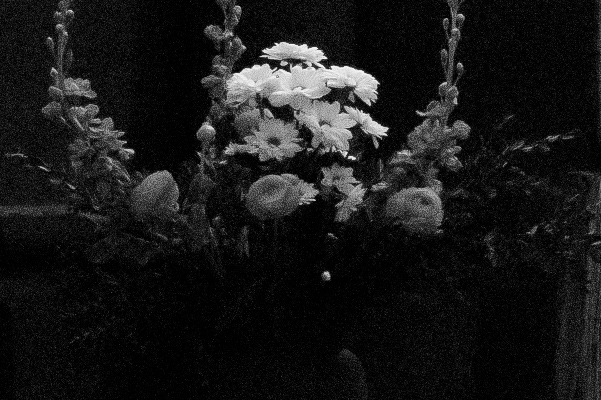
ISO 10000
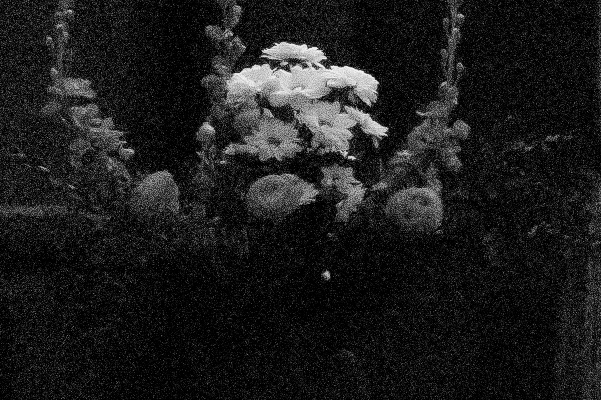
At ISO 10000, NR is going to to be needed in order to avoid bright speckle noise. Here, I used a Luminance NR amount of 25. You can see how the blacks clean up very nicely just with a bit of NR. The tight, non-blurred noise pattern of the M Monochrom makes this easy.

If you think the Leica M Monochrom or 50mm APO-Summicron could be for you, consider placing a pre-order through Dale Photo & Digital. Dale Photo is one of the largest and most knowledgeable Leica dealers in the USA. No deposit or prepayment is necessary. Call 1-800-327-1776 with any questions, or email me at [EMAIL=david@dalephotoanddigital.com]david@dalephotoanddigital.com[/EMAIL].
-
David Farkas replied to the topic Leica M Monochrom in the forum M Monochrom 14 years, 2 months ago
tinchohs;2399 wrote: I have shot mostly color in my M9. But lately, I've been considering working for a while exclusively in B&W. I'm curious if I can make it work for me.
With the arrival of the MM I am very tempted. And yet I wonder if for my scenario it's not better to buy an M6 and shoot film for B&W and wait for an M10 for my deep…
-
tinchohs replied to the topic Leica M Monochrom in the forum M Monochrom 14 years, 2 months ago
I have shot mostly color in my M9. But lately, I've been considering working for a while exclusively in B&W. I'm curious if I can make it work for me.
With the arrival of the MM I am very tempted. And yet I wonder if for my scenario it's not better to buy an M6 and shoot film for B&W and wait for an M10 for my deep desire of a camera…[Read more]
-
GMB replied to the topic S2 dead–any help appreciated in the forum S2 14 years, 2 months ago
David Farkas;2388 wrote: Georg,
I'm a little late to the party (I'm 6 hours behind here in the US),
And I thought you be monitoring this 24/7???…Just kidding :D:D:D.
My dealer already offered to send the battery to Leica and ask for a replacement. Anyway, the thought that this could have happened during my safari in January…[Read more]
-
Jack MacD replied to the topic My Leica M Monochrom review is up! in the forum M Monochrom 14 years, 2 months ago
David,
Extremely well done. When you kept saying you were working hard on some updates of the new products, I kept asking myself, why is it taking so long? Now I understand. You provided detail on the Monochrom that exists in no other place. I have previously digitally converted about 1/4 of my shots into B&W. Initially my reaction was why…[Read more] - Load More